


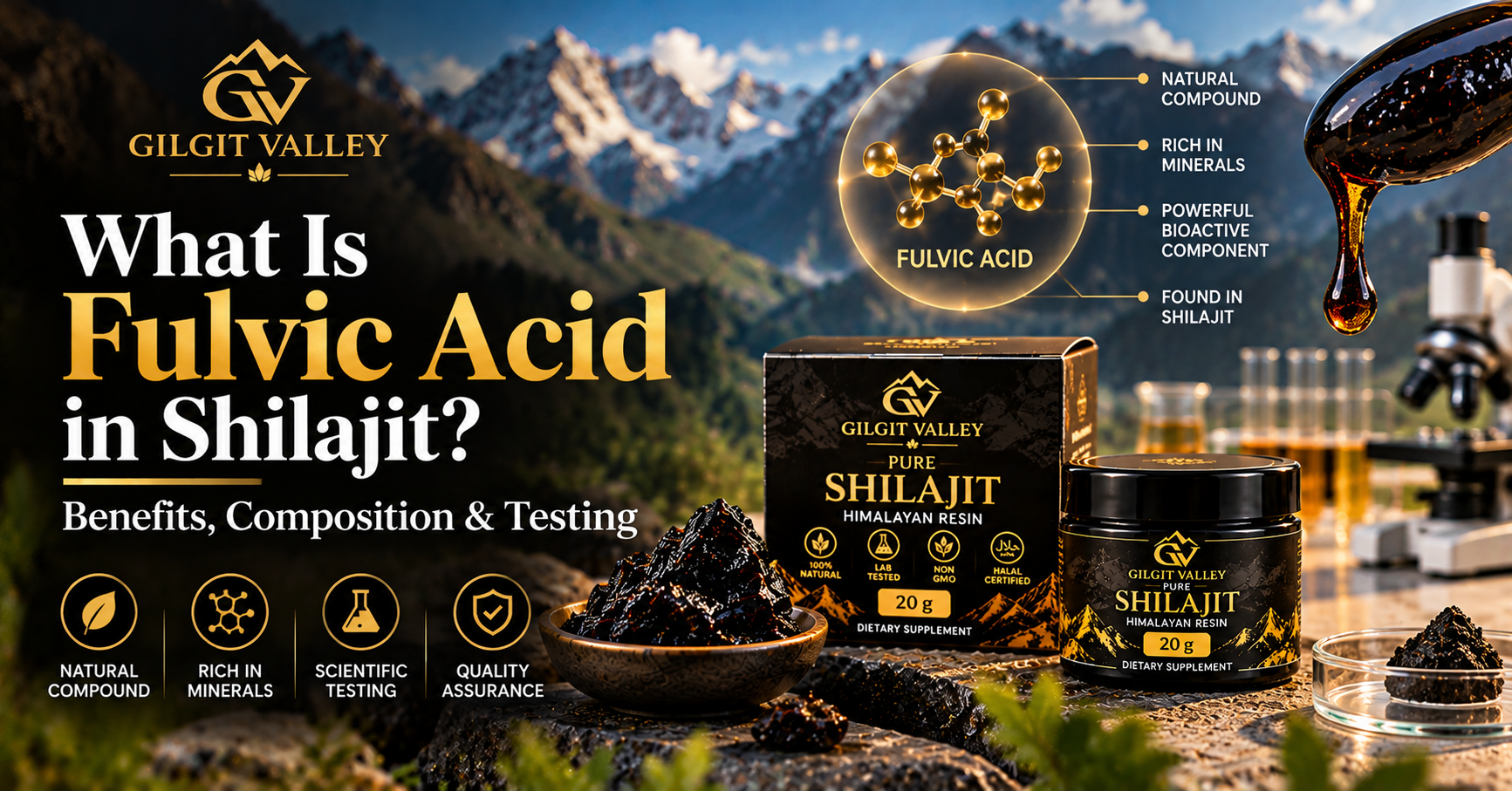
Fulvic acid is one of the most discussed components of Shilajit, a naturally occurring substance found in mountainous regions, including the Himalayas. It forms through the gradual breakdown of organic matter and contributes to the complex mixture of organic compounds found in Shilajit.
At Gilgit Valley, we understand that many customers consider fulvic acid when comparing Shilajit products. However, its presence alone does not prove that a product is pure, authentic, or safe. Understanding what fulvic acid is, how laboratories measure it, and what it indicates about product quality can help you make a more informed purchasing decision.
What Is Fulvic Acid?
Fulvic acid refers to a group of complex organic substances produced during the decomposition of plant and other organic materials. It belongs to a broader class of substances known as humic substances, which occur naturally in soil, water, and organic-rich environments.
Fulvic acid is known for its relatively small molecular size and its ability to interact with various minerals and other compounds. Its chemical composition can vary depending on its source and the conditions in which it forms.
In Shilajit, fulvic acid is part of a much more complex mixture that may include other organic compounds, minerals, and naturally occurring substances.
Why Is Fulvic Acid Found in Shilajit?
Shilajit develops over long periods through complex natural processes involving organic material and geological conditions. During this process, various organic compounds form and become part of the resulting substance.
Fulvic substances are associated with the organic composition of Shilajit. However, Shilajit is not simply fulvic acid. Its overall composition depends on its origin, collection methods, processing, and purification.
This is why two Shilajit products may have different chemical profiles even when both are marketed as Himalayan Shilajit.
What Does Fulvic Acid Do in Shilajit?
Fulvic acid is often discussed because of its chemical properties and its ability to interact with minerals. However, these properties should not be confused with proven health benefits from consuming Shilajit.
Researchers continue to study fulvic substances and their potential biological effects. Evidence from laboratory research does not automatically establish that a particular Shilajit product delivers the same effects in humans.
It is also important to understand that a higher stated fulvic acid percentage does not necessarily mean a product is better, more authentic, or more effective. Product quality depends on several factors, including composition, purity, contamination testing, and manufacturing controls.
How Is Fulvic Acid Measured in Shilajit?
Fulvic acid content can be assessed through laboratory analysis, but the result depends on the analytical method used. Different methods may measure or classify organic fractions differently, so reported percentages should be interpreted in context.
When reviewing a Shilajit laboratory report, consider these points:
- Testing method: Check which analytical method was used to measure fulvic acid.
- Reported result: Look for the measured value, units, and any stated limitations.
- Product or batch identification: Confirm that the report corresponds to the product and batch being sold.
- Safety testing: Check whether the report also covers relevant contaminants, such as heavy metals and microbial contamination.
- Laboratory details: Review the laboratory’s identity, testing date, and relevant accreditation or quality credentials.
A fulvic acid result alone cannot establish that Shilajit is free from contaminants. Safety and composition require separate assessment.
How to Choose Shilajit Based on Quality
Fulvic acid can be one useful piece of information when comparing Shilajit products, but it should not be the only deciding factor.
Before buying Shilajit resin, consider the product’s sourcing information, purification process, ingredient transparency, packaging, and availability of credible laboratory results. A useful report should identify the tested sample and clearly state which parameters were assessed.
Be cautious of products that make guaranteed health claims or advertise exceptionally high fulvic acid percentages without reliable supporting documentation. Before purchasing, consider the key quality checks covered in How to Identify Real Shilajit: 10 Things to Check Before Buying.
For Gilgit Valley, transparent sourcing information and verifiable, batch-specific testing can help customers assess product quality more confidently. Any claim that a product is lab-tested should be supported by actual test documentation.
Conclusion
Fulvic acid is an important part of the discussion around Shilajit because it is associated with its naturally occurring organic compounds. However, it is only one aspect of Shilajit’s complex composition and cannot, on its own, establish authenticity, safety, or effectiveness.
When comparing Shilajit products, consider laboratory evidence, contaminant testing, sourcing, and overall product transparency rather than relying on a single percentage or marketing claim.
Frequently Asked Questions
Q1. What is fulvic acid in Shilajit?
A: Fulvic acid refers to a group of complex organic substances associated with the organic composition of Shilajit. It is one component of a broader mixture of naturally occurring compounds.
Q2. Is fulvic acid the same as Shilajit?
A: No. Shilajit is a complex natural substance containing various organic and inorganic components. Fulvic acid is only one part of its composition.
Q3. Does a higher fulvic acid percentage mean better Shilajit?
A: Not necessarily. A higher reported percentage does not automatically establish purity, safety, authenticity, or better results. The testing method and the product’s overall quality also matter.
Q4. Can fulvic acid prove that Shilajit is pure?
A: No. Fulvic acid analysis alone cannot prove purity or rule out contamination. Reliable quality assessment may require additional laboratory tests, including relevant heavy metal and microbial testing.
Q5. How can I check the fulvic acid content of Shilajit?
A: Look for a credible laboratory report that identifies the tested sample, explains the analytical method, and reports the measured result. Confirm that the report relates to the specific product or batch you are considering.