


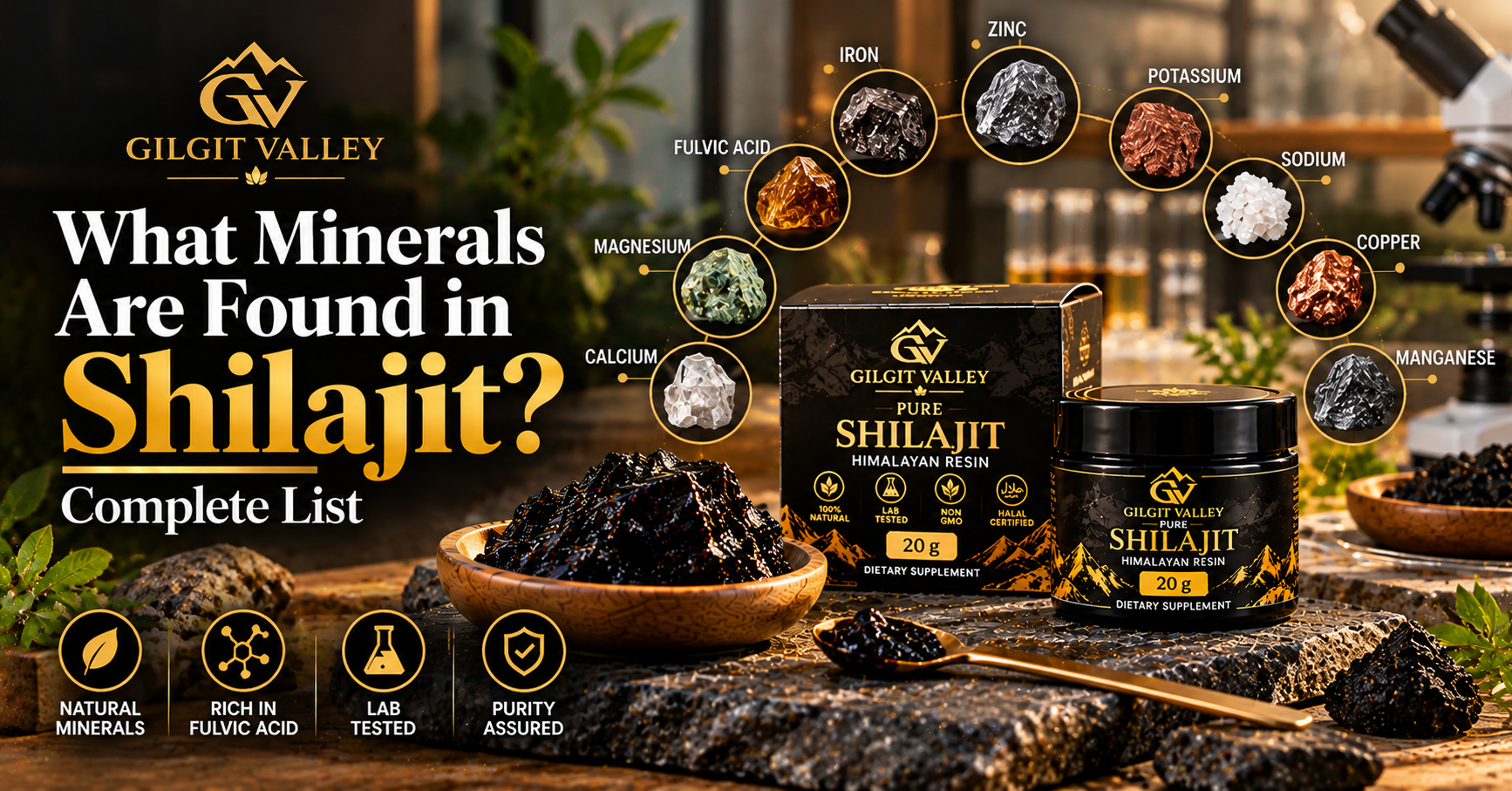
Shilajit is a naturally occurring substance found in mountainous regions, including the Himalayas. It contains a complex mixture of organic compounds and inorganic constituents, including minerals and trace elements. Its composition can vary depending on its geographical origin, surrounding geology, collection methods, and purification process. In the Gilgit Valley, understanding the natural composition of Pure Shilajit is an important part of helping customers make informed decisions when choosing this traditional natural product.
Minerals are often discussed when comparing different types of Shilajit, but not every sample contains the same elements or concentrations. Some minerals may occur in small amounts, while other elements can be present as unwanted contaminants. Understanding the difference between naturally occurring mineral content and product safety helps consumers evaluate Shilajit more carefully.
Which Minerals Are Found in Shilajit?
Shilajit may contain several mineral elements, including potassium, calcium, magnesium, iron, zinc, and manganese. Other elements may also be detected depending on the sample and the analytical method used.
Here is a closer look at some commonly discussed minerals and their roles in the human body.
Potassium: Potassium is an essential mineral involved in normal nerve signalling, muscle function, and fluid balance. However, the amount present in a particular Shilajit product must be confirmed through laboratory analysis.
Calcium: Calcium supports bones and teeth and plays an important role in muscle contraction and nerve function. Its presence in Shilajit does not necessarily mean the product provides a significant dietary source.
Magnesium: Magnesium contributes to normal muscle and nerve function and participates in many processes involved in energy metabolism. The concentration of magnesium in Shilajit can vary between samples.
Iron: Iron helps the body produce haemoglobin, a protein that carries oxygen in the blood. Detecting iron in a Shilajit sample does not establish that it provides enough iron to meet daily nutritional requirements.
Zinc: Zinc supports normal immune function, wound healing, and numerous enzyme activities. Its actual concentration in Shilajit should be verified rather than assumed.
Manganese: Manganese is involved in enzyme activity, metabolism, and bone formation. Like other elements, its presence and concentration depend on the composition of the individual sample.
These minerals have important functions in human nutrition, but their presence in Shilajit does not automatically mean that a serving provides nutritionally meaningful amounts. A reliable assessment requires measured concentrations and information about the serving size.
Does Shilajit Contain Trace Minerals?
Shilajit may contain trace elements in addition to minerals present at higher concentrations. Trace elements occur in relatively small amounts, and their presence can be influenced by the geological conditions surrounding the material.
However, the term trace mineral does not automatically mean that an element is beneficial. Some elements are essential to the body in appropriate amounts, while others may be harmful depending on their concentration and level of exposure.
For example, lead, arsenic, cadmium, and mercury are contaminants that require careful monitoring in products intended for consumption. Their presence and potential risk depend on the measured levels and applicable safety standards.
This distinction is important when evaluating Shilajit. A product may contain naturally occurring minerals, but that alone does not establish its purity or safety. Mineral composition and contaminant levels need to be assessed separately.
Why Does Mineral Content Vary in Shilajit?
The mineral profile of Shilajit is not identical across all sources or products. Several factors can influence its final composition.
- Geographical origin
The surrounding rocks, soil, and geological conditions can affect which elements occur in naturally collected material. Shilajit from different mountainous regions may therefore have different chemical profiles.
- Natural composition
Shilajit is a complex substance rather than a single chemical compound. Its proportions of organic compounds and inorganic constituents can differ from one sample to another.
- Collection and purification
The way raw material is collected, handled, processed, and purified may influence the composition of the final product. Appropriate processing is important, but claims about a particular purification method should be supported by accurate product information.
- Laboratory testing methods
Different analytical methods can identify and quantify elements in different ways. The testing method, units, detection limits, and laboratory procedures all matter when interpreting a mineral report.
Because of these variations, a mineral list published for one Shilajit sample should not be treated as proof that every Shilajit product contains the same elements or amounts.
How Can You Check the Mineral Content of Shilajit?
The most reliable way to assess the mineral profile of a particular Shilajit product is through appropriate laboratory testing. Product descriptions and general mineral lists may provide background information, but they cannot confirm the exact composition of an individual batch.
When reviewing a laboratory report, consider the following points:
- Elemental analysis: Check which minerals and other elements were actually tested and review their reported concentrations.
- Heavy metal testing: Look for results covering relevant contaminants, including lead, arsenic, cadmium, and mercury.
- Units and detection limits: Results may be reported in milligrams per kilogram (mg/kg) or other units. Make sure the values are interpreted correctly.
- Batch identification: Confirm that the tested sample corresponds to the product or batch being sold.
- Laboratory details: Review the laboratory’s identity, testing date, analytical methods, and relevant quality credentials.
The How Is Shilajit Lab Tested? A Complete Guide explains how laboratory reports help assess Shilajit composition and why contaminant testing matters when evaluating product quality.
However, laboratory results have limitations. A report that lists a few minerals does not confirm that the laboratory tested for every potential contaminant. Similarly, a mineral analysis does not prove specific health benefits or establish that a product is suitable for everyone.
Does Higher Mineral Content Mean Better Shilajit?
A higher mineral concentration does not automatically mean that Shilajit is better. Overall quality depends on several factors, including its composition, sourcing transparency, processing, contaminant levels, and the reliability of supporting documentation.
The type of mineral also matters. Essential minerals can play important roles in the human body, but the presence of a particular element is not enough to establish its nutritional value in a supplement. The concentration, amount consumed, and available scientific evidence all need to be considered.
Consumers should also be cautious of marketing claims that present a long list of minerals as proof of superior quality. Without reliable analytical results, such lists may not accurately represent the product being sold.
For Gilgit Valley, clear product information and verifiable testing documentation can help customers understand what is known about the product. Any claim about specific minerals, their concentrations, purification methods, or laboratory testing should be supported by evidence relevant to the actual product.
Conclusion
Shilajit may contain minerals such as potassium, calcium, magnesium, iron, zinc, and manganese, along with other naturally occurring elements. However, its mineral profile can vary depending on its origin, natural composition, collection, and processing.
The presence of minerals does not automatically establish that a Shilajit product is pure, safe, or nutritionally beneficial. Some elements may also be unwanted contaminants, making appropriate laboratory testing an important part of quality assessment.
When choosing Shilajit, look beyond general mineral lists and unsupported marketing claims. Consider the product’s sourcing information, composition data, and relevant laboratory results. A transparent approach helps you make informed decisions and understand what mineral content can and cannot tell you about Shilajit. Shop Now to find Gilgit Valley Pure Shilajit Resin in 10g, 20g, and 30g sizes.
Frequently Asked Questions
1. What minerals are found in Shilajit?
Shilajit may contain potassium, calcium, magnesium, iron, zinc, manganese, and other elements. The exact mineral profile varies between samples and should be confirmed through appropriate laboratory analysis.
2. Does Shilajit contain all essential minerals?
No. Shilajit should not be assumed to contain every essential mineral or to provide them in nutritionally meaningful amounts. Its composition depends on the individual sample.
A3. Does Shilajit contain iron and magnesium?
Some Shilajit samples may contain iron and magnesium. Their presence and concentrations should be verified through suitable elemental analysis rather than assumed for every product.
Q4. Can the minerals in Shilajit help treat mineral deficiencies?
The presence of minerals in Shilajit does not establish that it can prevent or treat a nutritional deficiency. The amount present per serving and the evidence for the specific product matter. Shilajit should not replace a balanced diet, appropriate medical advice, or prescribed treatment.
Q5. How can I verify the mineral content of Shilajit?
Look for a credible laboratory report that identifies the tested sample, lists the elements measured, and provides their concentrations. Review relevant heavy metal results separately because mineral analysis alone does not establish overall product safety.