
Buying Shilajit can be confusing, especially when different brands claim to offer pure, authentic, or premium Himalayan Shilajit. Product descriptions may mention high fulvic acid content, natural minerals, mountain origins, and traditional preparation methods. However, these claims do not automatically prove that a product is genuine, properly purified, or safe for consumption.
So, how can you identify real Shilajit before buying it?
The most reliable approach is to evaluate the product’s sourcing, ingredients, purification process, laboratory testing, packaging, and seller transparency. Physical characteristics such as color, texture, and smell may describe a product, but they cannot independently confirm its authenticity. Gilgit Valley recommends checking verified product information, quality standards, and testing documentation before purchasing Shilajit resin to make a more informed decision.
Verify the Source and Ingredients
1. Check the Shilajit’s Origin
Authentic Shilajit is associated with mountainous environments, including the Himalayan region. However, a claim such as “Himalayan Shilajit” or “high-altitude Shilajit” does not, by itself, prove where a particular product was collected.
Before purchasing, check whether the brand explains its sourcing location and provides credible information about its supply chain. Look for specific geographical details rather than relying exclusively on mountain imagery or general origin claims.
For customers considering Gilgit Valley, clear and verifiable sourcing information should be an important part of the purchasing decision.
2. Read the Ingredient List Carefully
A product labeled as pure Shilajit resin should clearly state its ingredients. Check whether the label lists Shilajit resin alone or includes other ingredients, such as added extracts, fillers, or binders.
Compare the ingredient list on the packaging with the information displayed on the website. If the description and label do not match, ask the seller for clarification before purchasing.
Also check the net quantity, manufacturer or seller details, serving instructions, and relevant warnings. Transparent labeling helps you understand exactly what you are buying.
Evaluate Purification and Laboratory Evidence
3. Ask About the Purification Process
Raw Shilajit is not automatically suitable for consumption. Its composition and potential contaminants can vary depending on its source, collection, handling, and processing.
A responsible brand should be able to explain how it processes and purifies its Shilajit. Look for a clear description of its quality-control procedures rather than unsupported statements such as “100% pure” or “completely toxin-free.”
Purification claims should be supported by appropriate process information and, where relevant, laboratory evidence. A claimed purification process alone does not guarantee that the finished product meets safety standards.
4. Check for a Valid Laboratory Report
Laboratory testing is one of the most useful ways to evaluate a Shilajit product. Ask the seller for a relevant Certificate of Analysis (COA) or laboratory test report.
When reviewing the document, check:
- The product or sample identification.
- The batch number, where applicable.
- The laboratory’s name and relevant credentials.
- The date and scope of testing.
- The analytical methods and reported results.
A report is more useful when it can be linked to the actual product or batch being sold. If the document is unclear or cannot be verified, request further information.
5. Look for Heavy Metal and Microbial Testing
Shilajit can contain naturally occurring elements, but certain contaminants may present health risks if their concentrations exceed appropriate limits.
Depending on the product and applicable requirements, relevant laboratory testing may include heavy metals such as lead, arsenic, cadmium, and mercury. Microbial testing can also help assess whether a sample meets applicable microbiological safety criteria.
Check which parameters were actually tested rather than assuming a product has undergone comprehensive safety testing simply because the seller displays a “lab tested” badge.
Important: A report covering one parameter does not establish that every possible contaminant has been assessed. Review the scope and results of the testing before concluding product safety.
Understand Physical Characteristics and Composition
6. Examine the Color and Texture—Without Relying on Appearance Alone
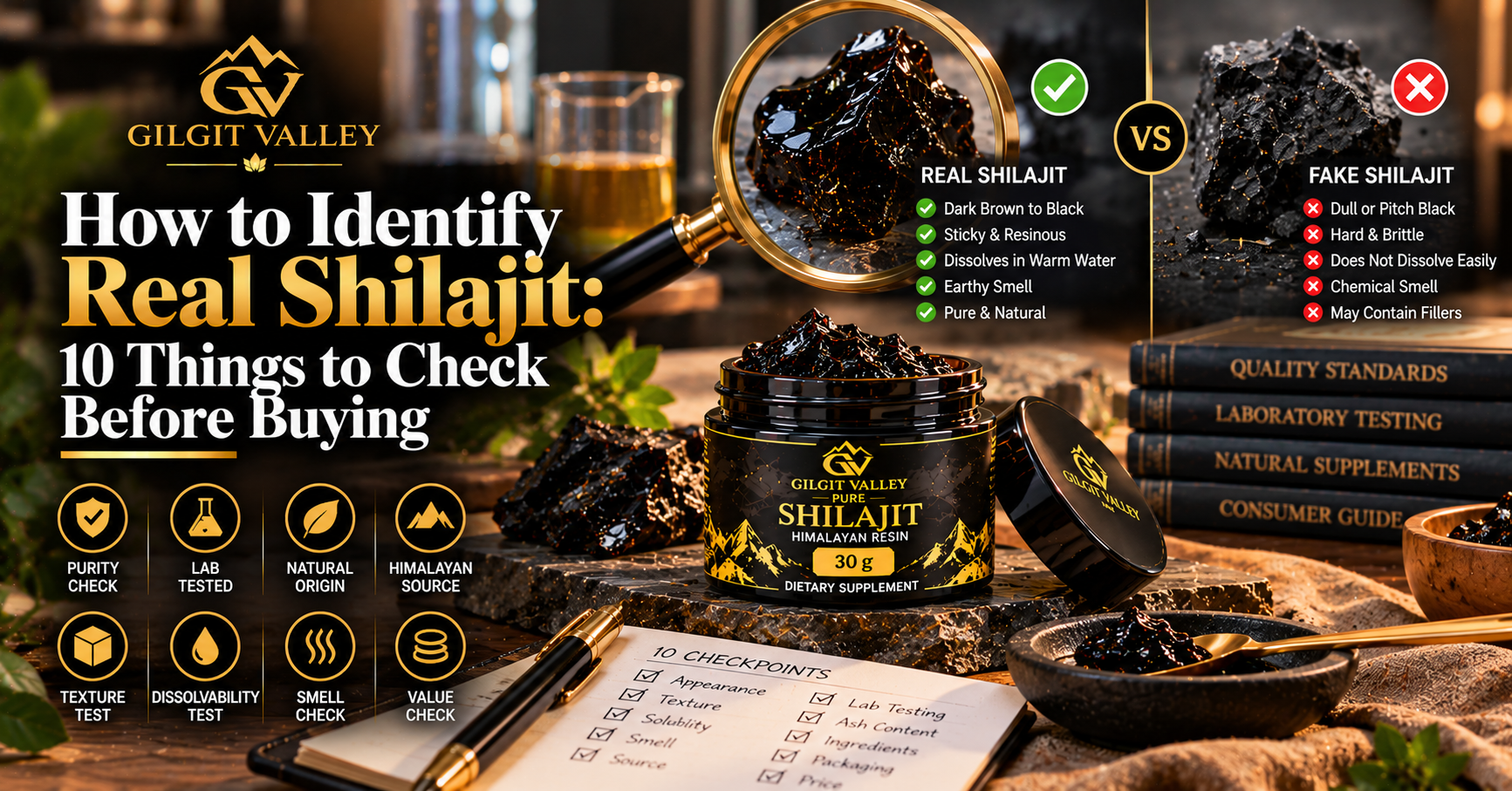
Shilajit resin is commonly dark brown to nearly black and may have a sticky, dense consistency. Its physical properties can change with temperature and moisture.
However, appearance varies between products, and other substances can resemble genuine Shilajit. Color and texture alone cannot establish authenticity or reveal whether harmful contaminants are present.
Be cautious of online demonstrations that claim a single visual characteristic proves a product is genuine or fake. Treat physical observations as descriptive information, not definitive verification.
7. Review Fulvic Acid and Mineral Claims
Fulvic acid and mineral content are frequently highlighted in Shilajit marketing. However, concentrations and composition can vary depending on the source, processing methods, and individual batch.
If a brand advertises a specific fulvic acid percentage or a particular mineral profile, look for appropriate analytical evidence supporting that claim.
A higher advertised percentage or larger mineral count does not automatically mean a product is safer or better. The testing method, accuracy of the results, and overall product quality also matter.
Choose brands that distinguish between general information about Shilajit and laboratory findings for their specific products.
Assess Packaging and Seller Credibility
8. Inspect the Packaging and Product Information
Packaging is an important part of product identification, although attractive packaging does not prove authenticity.
Before ordering, check whether the product has:
- A clearly stated net quantity, such as 10g, 20g, or 30g.
- An ingredient list and serving instructions.
- Appropriate storage information.
- Manufacturer or seller details.
- Batch identification and expiry or best-before information, where applicable.
- Intact, properly sealed packaging when delivered.
Avoid products with missing labels, unexplained alterations, inconsistent product information, or damaged seals. Contact the seller if important details are missing.
9. Evaluate the Brand’s Transparency and Customer Support
A trustworthy seller should make it reasonably easy for customers to ask questions about sourcing, processing, testing, and product specifications.
Review the brand’s website, contact information, shipping and return policies, and product descriptions. Customer reviews may provide useful context, but reviews alone cannot verify a product’s chemical composition or safety.
Be cautious when a seller makes dramatic health promises, refuses to explain testing claims, or uses pressure-based marketing to discourage careful comparison.
For Gilgit Valley customers, the goal should be to make purchasing decisions based on clear product information, verifiable evidence, and accessible customer support—not marketing language alone.
Compare Products Before Making a Purchase
10. Compare Quality Evidence, Not Just Price
Shilajit prices can vary according to product quantity, sourcing, processing, testing, packaging, and the seller’s business model. A low price does not automatically indicate a counterfeit product, and a high price does not guarantee purity.
Before choosing a product, compare the following:
| What to Compare | What to Look For |
| Origin | Clear and credible sourcing information |
| Ingredients | Accurate labeling and product description |
| Purification | Explained processing and quality-control practices |
| Lab testing | Relevant, verifiable results |
| Fulvic acid claims | Analytical support for specific percentages |
| Quantity | Clearly stated net weight |
| Packaging | Appropriate labeling and intact seals |
| Customer support | Accessible contact details and transparent policies |
| Price | Value relative to quantity and available quality evidence |
| Usage information | Clear serving instructions and relevant warnings |
If a brand cannot answer basic questions about its product, consider comparing other options before placing an order.
Gilgit Valley aims to help customers make informed decisions by emphasizing transparent product information and responsible quality practices. Before purchasing any Shilajit resin, use the same checklist to assess the evidence available for the product you are considering.
Conclusion
Identifying real Shilajit requires more than checking its color, smell, texture, or behavior in water. These physical characteristics cannot independently establish authenticity or safety.
Instead, focus on 10 important factors: sourcing, ingredients, purification, laboratory reports, contaminant testing, physical characteristics, fulvic acid and mineral claims, packaging, seller transparency, and overall value.
Whenever possible, request relevant laboratory documentation and check whether it corresponds to the product or batch being sold. Be cautious of unsupported health promises, exaggerated purity claims, and sellers who cannot explain their quality-control practices.
At Gilgit Valley, we believe customers should have access to clear product information that supports informed purchasing decisions. By asking the right questions and prioritizing verifiable evidence, you can make a more confident choice when buying Shilajit resin.
Frequently Asked Questions
Q1. How can I identify real Shilajit at home?
A: You cannot reliably confirm authenticity at home using color, smell, texture, or a water test alone. Check the seller’s sourcing information, ingredients, purification practices, and relevant laboratory reports for more reliable evidence.
Q2. What color is real Shilajit?
A: Shilajit resin is commonly dark brown to nearly black, but its appearance can vary. Color alone cannot establish whether a product is genuine, pure, or safe.
Q3. Does real Shilajit dissolve in water?
A: Shilajit resin may disperse or dissolve in water depending on its composition and the conditions. However, this behavior is not a definitive authenticity test because other substances may behave similarly.
Q4. How can I check whether Shilajit is lab tested?
A: Request a relevant Certificate of Analysis or laboratory report. Review the product or batch identification, laboratory details, testing date, parameters assessed, and reported results. Where possible, verify the report with the laboratory.
Q5. Is expensive Shilajit always better quality?
A: No. Price alone does not establish authenticity, purity, or safety. Compare the product’s ingredients, sourcing information, purification practices, laboratory evidence, net quantity, and seller transparency before making a decision.