


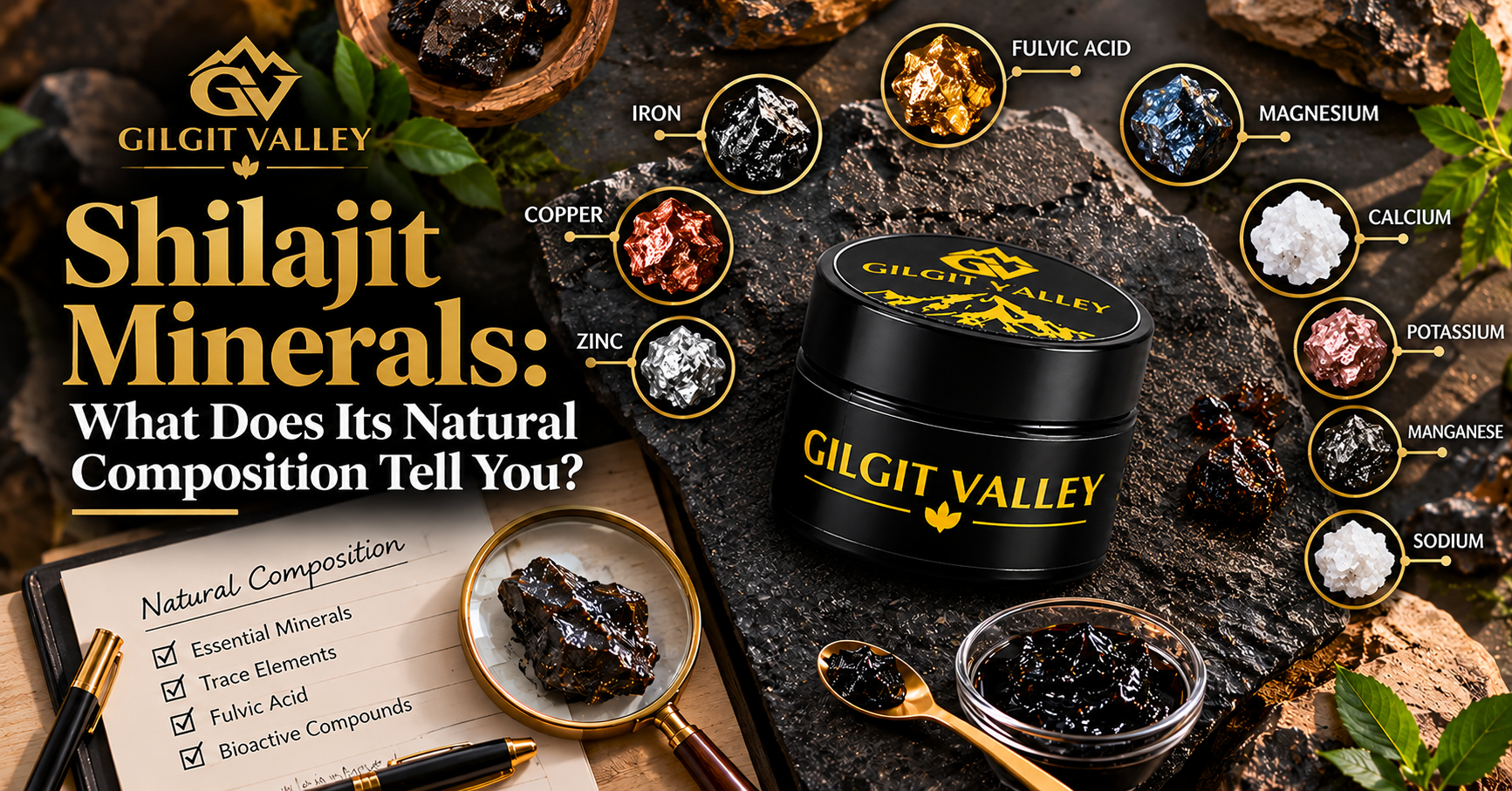
Shilajit is a naturally occurring, dark-coloured substance found in mountainous regions, including the Himalayas. It contains a complex mixture of organic compounds, mineral elements, and other naturally occurring constituents. Its composition has attracted scientific interest because researchers are investigating how these components vary between samples and what they reveal about product quality.
At Gilgit Valley, we believe that understanding Shilajit’s natural composition helps customers make more informed purchasing decisions. Analyses of Shilajit have identified minerals such as calcium, magnesium, potassium, iron, and zinc, although their presence and concentrations can vary depending on the sample’s origin and processing.
Understanding which minerals Shilajit contains, how laboratories measure them, and why testing matters can help you evaluate product information more carefully.
What Minerals Are Found in Shilajit?
Researchers have identified several mineral elements in different Shilajit samples. However, not every sample contains the same elements at the same concentrations. A mineral’s presence in one tested sample does not establish its concentration in every commercially available product.
Commonly reported elements include:
- Calcium: An essential mineral involved in normal bone structure, muscle function, and nerve signalling.
- Magnesium: Supports normal muscle and nerve function and participates in many biochemical processes.
- Potassium: Helps regulate fluid balance, nerve signalling, and muscle contractions.
- Iron: Plays an important role in haemoglobin formation and oxygen transport.
- Zinc: Supports normal immune function, wound healing, and various enzymatic processes.
- Selenium: An essential trace element involved in antioxidant enzyme systems and normal thyroid function.
Scientific reviews describe calcium, potassium, and magnesium among the major mineral elements reported in Shilajit, alongside various trace elements. However, researchers have also documented considerable differences in its chemical composition.
The presence of these elements does not automatically mean that Shilajit supplies nutritionally significant amounts of them. To determine the amount present, you need reliable analytical results for the specific product.
Calcium in Shilajit: What Does It Tell You?
Calcium is an essential mineral that supports normal bone structure, muscle contraction, and nerve function. Researchers have identified calcium in Shilajit, but its concentration and chemical form can vary between samples.
The presence of calcium alone does not establish how much a serving of Shilajit contributes to a person’s daily calcium requirements. That assessment requires accurate concentration data, serving information, and an understanding of how the body absorbs the mineral.
When comparing Shilajit products, look for product-specific laboratory information rather than assuming that all resin contains the same amount of calcium.
Magnesium in Shilajit: Understanding Its Role
Magnesium participates in hundreds of biochemical reactions in the human body, including processes involved in normal muscle function, nerve signalling, and energy metabolism.
Researchers have reported magnesium in Shilajit samples, but its concentration may differ according to geographical origin, processing, and the sample analysed.
A product’s natural magnesium content should not be confused with a proven magnesium supplement dose. Without reliable measurements of the actual product, you cannot determine how much magnesium a serving provides.
Potassium in Shilajit: An Essential Mineral
Potassium helps maintain normal fluid balance and supports nerve signalling and muscle contractions. It is an essential dietary mineral found in many foods.
Chemical analyses have identified potassium in Shilajit, but the reported amount varies between samples. Its presence alone does not establish that a Shilajit product provides a meaningful dietary source of potassium or produces a specific health benefit.
Customers should therefore evaluate verified product composition rather than relying on general claims about mineral richness.
Trace Minerals in Shilajit
In addition to major mineral elements, researchers have identified trace elements such as iron, zinc, manganese, selenium, and other elements in certain Shilajit samples.
The term trace element refers to an element present in a relatively small amount. Some trace elements are essential for normal biological functions, while others may present health risks depending on their chemical form, concentration, and exposure.
This distinction matters when evaluating Shilajit. A natural material can contain both desirable mineral elements and unwanted contaminants. Its origin alone does not establish that every constituent is beneficial or safe.
A reliable assessment requires appropriate analytical methods and results that identify which elements the laboratory measured.
Fulvic Acid and Minerals in Shilajit
Fulvic acid is frequently discussed in relation to Shilajit’s composition. It belongs to a broader group of humic substances associated with complex organic materials.
Researchers examine fulvic acid and other organic constituents alongside mineral elements to understand Shilajit’s chemical profile. These components are different: fulvic acid is an organic substance, whereas calcium, magnesium, and potassium are mineral elements.
A reported fulvic acid percentage does not tell you the concentration of every mineral in a product. Likewise, a mineral analysis does not establish the product’s fulvic acid content unless the laboratory specifically measures it using an appropriate method.
When comparing products, consider each measurement separately and check whether the available documentation supports the stated values.
Why Does Shilajit’s Mineral Composition Vary?
Shilajit is a complex natural material, and its composition is not uniform across all sources. Research has documented variation in mineral elements and other constituents among samples collected from different geographical regions. <Cite refs={[“turn518181search0″,”turn518181search6”]}/>
Several factors may contribute to these differences:
- Geographical origin
Local geology and environmental conditions can influence the elements present in the material.
- Natural composition
Shilajit contains a complex mixture of organic and inorganic constituents. Different samples may therefore have different chemical profiles.
- Processing and purification
The methods used to prepare Shilajit for consumption can influence its final composition. Manufacturers should provide accurate information about their processing practices.
- Testing methods
Different analytical methods measure different properties. Results must be interpreted according to the method used, the units reported, and the sample examined.
For these reasons, a mineral profile from one sample should not automatically be applied to every Shilajit product from the same region or brand.
How Is Shilajit’s Mineral Content Tested?
Laboratories use analytical techniques to identify and measure elements in a sample. Depending on the method and testing objective, these techniques may include inductively coupled plasma mass spectrometry (ICP-MS), atomic emission spectroscopy, or X-ray fluorescence (XRF).
Each method has its own capabilities and limitations. The results may also depend on sample preparation, calibration, detection limits, and the laboratory’s procedures.
When reviewing a mineral analysis, consider the following:
- Elements tested: Check whether the report identifies each element measured.
- Concentrations and units: Look for the reported values and units, such as milligrams per kilogram (mg/kg) or parts per million (ppm).
- Testing method: Confirm which analytical technique the laboratory used.
- Sample identity: Check whether the report identifies the product or batch being evaluated.
- Safety testing: Determine whether the laboratory also assessed relevant contaminants, including lead, arsenic, cadmium, mercury, and microbial contamination.
A mineral profile and a contaminant assessment serve different purposes. A report that measures selected minerals does not automatically establish that the laboratory tested for every relevant contaminant.
For further information about laboratory methods and product testing, see How Is Shilajit Lab Tested? A Complete Guide.
Do More Minerals Mean Better-Quality Shilajit?
Not necessarily. A higher mineral concentration does not automatically indicate better quality, greater purity, or superior health benefits.
Mineral composition is only one part of a product’s overall chemical profile. Quality assessment should also consider sourcing, processing, appropriate contaminant testing, product labelling, and the reliability of supporting documentation.
Some elements are essential nutrients, while others can be harmful at excessive exposure levels. The significance of a reported concentration depends on the element, its chemical form, the amount consumed, and the relevant safety criteria.
Customers should also be cautious of claims that a particular mineral count proves authenticity. Colour, texture, solubility, and mineral content alone cannot conclusively establish that a product is genuine or safe.
How to Evaluate Shilajit Quality Before Buying
Before choosing a Shilajit resin, consider the information the seller provides about its origin, preparation, composition, and testing.
- Check sourcing information: Look for clear details about where the product comes from and how the manufacturer handles it.
- Review processing details: Check whether the manufacturer explains how it prepares the material for consumption.
- Examine laboratory documentation: Look for credible results that identify the tested sample, the analytical methods, and the parameters assessed.
- Check contaminant testing: Appropriate testing can help assess risks associated with unwanted elements and microbial contamination.
- Avoid unsupported claims: Be cautious of guaranteed health outcomes, unverified mineral counts, and specific composition percentages without supporting evidence.
Choosing Gilgit Valley Pure Shilajit
At Gilgit Valley, we believe clear product information helps customers make informed purchasing decisions. Understanding the composition of Shilajit, the limits of mineral analysis, and the importance of appropriate quality testing can help you assess products more carefully.
Gilgit Valley Pure Shilajit Resin is available in 10g, 20g, and 30g pack sizes. Review the product details and available quality information before choosing the pack that suits your preferences.
Shop Gilgit Valley Pure Shilajit Resin and make your purchasing decision based on clear information, realistic expectations, and responsible product evaluation.
Conclusion
Shilajit contains a complex mixture of organic compounds and mineral elements, including calcium, magnesium, potassium, and various trace elements. However, its composition can vary considerably between samples, and the presence of a particular mineral does not guarantee a specific health benefit or establish product quality.
A reliable assessment considers the actual mineral concentrations, the analytical methods used, the product’s processing, and appropriate contaminant testing. No single measurement can establish every aspect of purity, authenticity, and safety.
At Gilgit Valley, we encourage customers to look beyond general mineral claims and consider transparent product information and credible supporting evidence when choosing Shilajit resin.
Frequently Asked Questions
Q1. What minerals are commonly found in Shilajit?
Researchers have identified calcium, magnesium, potassium, iron, zinc, and other trace elements in different Shilajit samples. However, the exact composition and concentration vary between samples and products.
Q2. Does Shilajit contain calcium and magnesium?
Yes, scientific analyses have reported calcium and magnesium in Shilajit samples. Their concentrations can vary, so product-specific laboratory results are necessary to determine the amounts present in a particular product.
Q3. Does Shilajit contain fulvic acid and minerals?
A: Shilajit contains complex organic substances, including fulvic acid, alongside inorganic constituents such as mineral elements. Fulvic acid content and mineral concentrations are separate measurements and require appropriate analytical methods.
Q4. Do more minerals mean better-quality Shilajit?
A: No. A higher mineral concentration does not automatically establish purity, safety, or better health outcomes. Quality assessment also requires appropriate processing information, transparent labelling, and relevant laboratory testing.
Q5. How can I check the mineral content of Shilajit?
A: Look for a credible laboratory report that identifies the tested sample, the elements measured, the analytical methods, and the reported concentrations. Check whether the report relates to the specific product or batch you intend to purchase.