


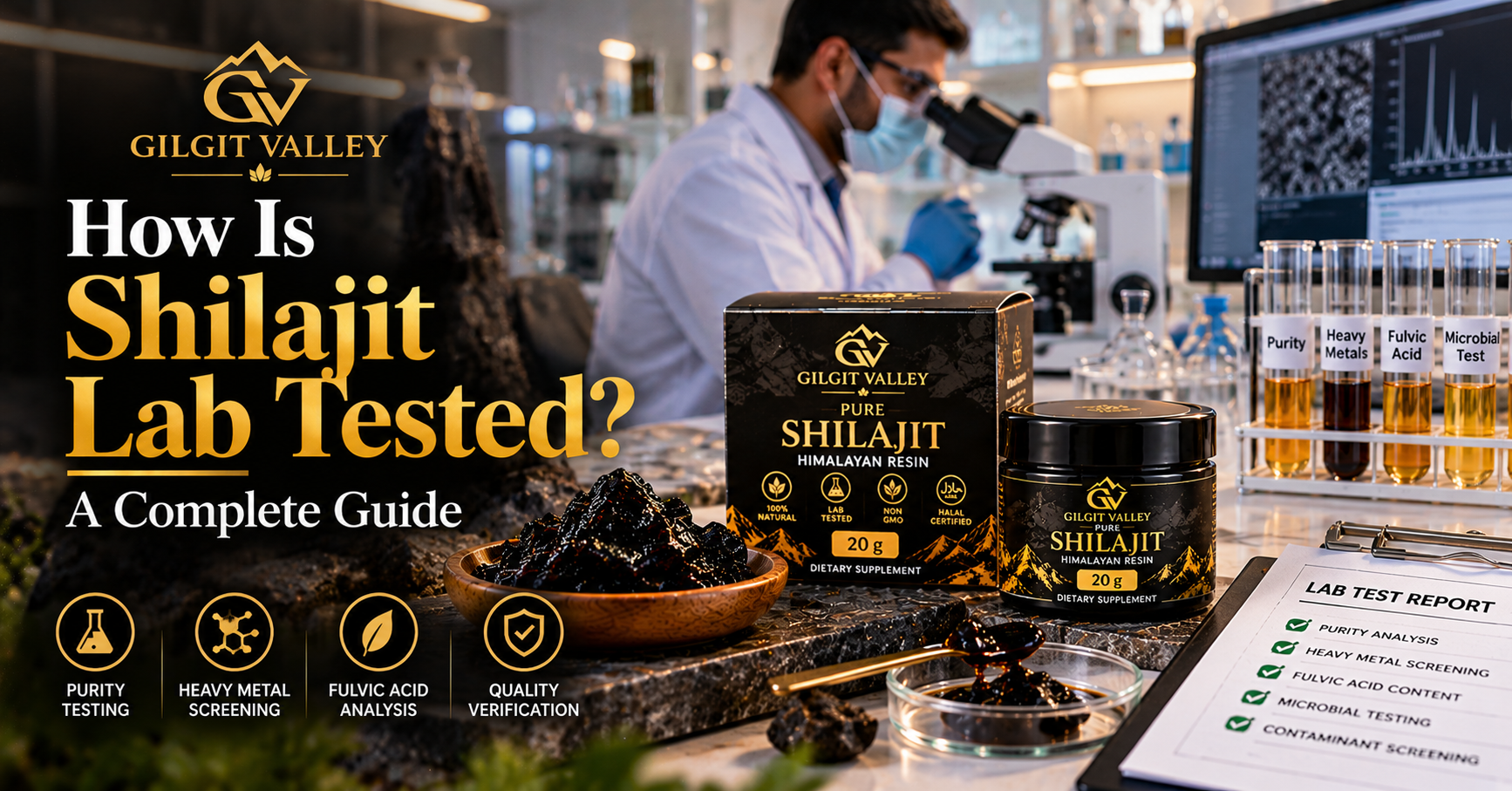
Shilajit is a naturally occurring substance with a complex composition of organic compounds and minerals. As demand for Shilajit resin grows, consumers increasingly focus on product quality, purity, and safety. However, a product’s natural origin or premium branding does not automatically guarantee that it is safe or free from contaminants.
This is where laboratory testing plays an important role. Shilajit lab testing involves analyzing a sample to assess specific characteristics, such as heavy metal concentrations, microbial contamination, and selected components of its composition. The exact tests performed depend on the product, the laboratory, and the manufacturer’s quality requirements.
Gilgit Valley explains how laboratories test Shilajit, which parameters they examine, how to interpret a Certificate of Analysis (COA), and why transparent quality information matters when choosing Shilajit resin.
Understanding the testing process helps customers evaluate product claims, review laboratory reports, and ask the right questions before purchasing.
Why Is Laboratory Testing Important for Shilajit?
Shilajit comes from natural geological environments, where its composition can vary according to its source and formation conditions.
Natural materials can contain unwanted elements or contaminants, so businesses must assess their quality before offering them for consumption.
Laboratory testing provides objective information about the sample under examination. It supports specific quality and safety claims, but its reliability depends on the tests performed, the methods used, and how accurately the sample represents the product being sold.
Some important reasons for testing Shilajit include:
- Assessing heavy metals: Certain metals can pose health risks when present above appropriate limits.
- Checking microbiological quality: Testing can identify specified microorganisms that may indicate a safety concern.
- Evaluating composition: Analytical methods may measure selected components, including fulvic acid, where appropriate.
- Supporting quality control: Testing can help manufacturers assess consistency between batches.
- Improving transparency: Relevant reports give customers evidence to evaluate specific product claims.
It is important to understand that no single laboratory test can establish every aspect of a product’s quality. A test for fulvic acid, for example, does not automatically demonstrate that the product meets heavy metal or microbial safety requirements.
For consumers, the most useful approach is to look for testing that addresses relevant safety parameters and clearly explains the results.
What Does a Shilajit Laboratory Test Check?
A Shilajit laboratory assessment may include several types of analysis. The appropriate testing panel depends on the product and the risks that need to be assessed.
Heavy Metal Testing
Heavy metal testing is an important consideration for Shilajit products. Depending on the laboratory’s testing panel, analysis may include lead, arsenic, cadmium, and mercury.
These elements can occur naturally in the environment, but excessive concentrations may present health risks. Compare laboratory results with the safety limits that apply to the product and jurisdiction.
When reviewing a report, check which metals the laboratory tested, their reported concentrations, the measurement units, and the applicable limits. A statement such as “heavy metals tested” provides limited information unless the report identifies the specific elements and discloses their results.
Microbial Testing
Microbiological testing evaluates whether a sample meets specified criteria for particular microorganisms. Depending on the testing panel, this may include relevant bacteria, yeast, or mould.
The exact tests and acceptable limits depend on the product category and applicable standards. A report should identify the organisms or parameters assessed rather than using a broad claim that implies every possible microorganism has been checked.
Fulvic Acid Analysis
Fulvic acid is an important component of Shilajit’s natural composition. Laboratories use appropriate analytical methods to measure or estimate its content.
However, results can depend on the method used. Different analytical procedures may not produce directly comparable values, so the testing method and interpretation matter.
Only advertise a specific fulvic acid percentage when relevant analytical evidence supports that claim for the product or sample in question.
Mineral and Composition Analysis
Shilajit may contain a range of mineral elements and other compounds. Laboratories can analyze selected constituents to help characterize a sample.
The presence of a mineral does not automatically establish a health benefit, and a larger mineral count does not necessarily indicate better quality. Composition results should be interpreted alongside safety testing and the product’s intended use.
Other Quality Parameters
Depending on the product and testing plan, additional analyses may be appropriate. These could include moisture content, identity-related testing, or other product-specific quality parameters.
Consumers should check the actual report to determine which tests were performed. Do not assume that every Shilajit product has undergone all these analyses simply because the seller describes it as laboratory tested.
How Is Shilajit Tested in a Laboratory?
The laboratory testing process generally involves several stages. Procedures vary according to the sample, the analytical method, and the laboratory’s quality system.
Step 1: Sample Identification and Preparation
The laboratory receives and identifies the sample submitted for testing. Relevant information may include the product name, batch or lot number, sample description, and requested tests.
The sample must be prepared appropriately for the selected analytical procedures. Reliable identification is important because a report is only useful to customers when its connection to the relevant product or batch is clear.
Step 2: Selection of Analytical Methods
The laboratory selects methods suitable for the parameters being examined.
For example, heavy metal analysis may use techniques such as inductively coupled plasma mass spectrometry (ICP-MS) or other suitable validated methods. Microbiological tests use different procedures designed to detect or quantify specified microorganisms.
A suitable method depends on the target substance, required sensitivity, sample characteristics, and relevant testing standards.
Step 3: Laboratory Analysis
The laboratory analyzes the sample using selected procedures. Depending on the test, it may measure a substance’s concentration, check for specific microorganisms, or identify selected components.
The laboratory reports the results in appropriate units and explains how to interpret them.
Step 4: Quality Checks and Result Review
Laboratories may use quality-control procedures, reference materials, calibration checks, blanks, or other controls appropriate to the analytical method.
These procedures help assess the reliability of the analytical process. The exact quality controls depend on the test being performed.
Step 5: Reporting the Results
After the analyses are completed and reviewed, the laboratory issues a report containing the relevant findings.
Depending on the testing scope, the report may include sample identification, methods, results, units, detection or quantification limits, and applicable reference criteria.
Customers should remember that a laboratory report describes only the sample the lab tested. It does not prove that every unit sold under the same brand has identical characteristics, especially when the report does not identify the relevant production batch.
How to Read a Shilajit Lab Report or Certificate of Analysis (COA)
A Certificate of Analysis (COA) is a document that reports analytical findings for an identified sample. It can help customers evaluate specific claims about Shilajit, provided the document is relevant and verifiable.
Here are the main details to check.
- Product and sample identification
Look for the product name, sample description, and batch or lot number where applicable. These details help establish which material was tested.
- Laboratory information
Check the laboratory’s name and contact details. Where relevant, verify its accreditation and whether the accreditation scope covers the tests shown in the report.
- Testing date
Review the date the sample was tested and the report was issued. A report for an older or unidentified sample may not establish the current status of the product you are purchasing.
- Parameters tested
Check the specific tests listed. A report that measures fulvic acid alone does not establish that heavy metals and microbial contaminants have also been assessed.
- Results and units
Review the actual findings and their units. If a result is reported as “not detected,” check the method’s detection limit where available. This does not necessarily mean that the substance is absolutely absent.
- Applicable safety criteria
If the report lists limits or acceptance criteria, check which standard the laboratory applies and whether that standard suits the product.
- Batch relevance and verification
Where possible, confirm that the report corresponds to the product or batch being sold. If the document’s authenticity is uncertain, contact the laboratory through independently verified contact information.
A useful COA clearly explains what the laboratory tested and what the results mean. A certificate image or laboratory logo alone is not sufficient evidence of comprehensive product safety.
How to Choose Lab-Tested Shilajit with Confidence
Laboratory testing is one part of responsible product selection. Consumers should also assess the brand’s sourcing information, ingredient labeling, processing practices, and willingness to explain its quality controls.
Before buying Shilajit resin, consider these practical steps:
- Ask for relevant test reports: Look for evidence covering appropriate safety and composition parameters.
- Check the batch information: Determine whether the report relates to the product or batch being sold.
- Review the testing scope: Confirm which parameters were actually assessed rather than relying on a general “lab tested” claim.
- Evaluate laboratory credentials: Verify the laboratory and the relevance of its qualifications to the tests performed.
- Read the product label: Check ingredients, net quantity, serving instructions, storage guidance, and relevant warnings.
- Look for transparent sourcing: A credible brand should provide clear information about its supply chain and processing practices.
- Be cautious with unsupported claims: Exact fulvic acid percentages, claims of complete contaminant removal, and statements of absolute purity require appropriate evidence.
For customers considering Gilgit Valley Pure Shilajit, transparency should be central to the purchasing experience. Any statement about laboratory testing, purification, or product composition should be supported by documentation relevant to the actual product.
A responsible approach does not rely on marketing claims alone. It gives customers clear information about what has been tested, what the results show, and what those results do not establish.
Conclusion
Shilajit laboratory testing helps assess important aspects of product composition and safety. Depending on the testing plan, analyses may cover heavy metals, microbial contamination, fulvic acid content, minerals, and other relevant quality parameters.
Understanding how laboratories identify samples, apply analytical methods, and report results helps you evaluate product claims. A valid, relevant Certificate of Analysis (COA) provides useful evidence when you can trace the report to the specific product or batch you plan to purchase.
However, no single test verifies every aspect of quality. Always interpret a report within the scope of the tests it covers.
At Gilgit Valley, we encourage informed purchasing decisions through clear product information and responsible quality practices. When you shop for Shilajit resin, review the testing details, ask for supporting evidence, and prioritize transparency over unsupported promises.
Frequently Asked Questions
Q1. What tests should be performed on Shilajit?
A: Relevant testing may include heavy metal analysis, microbiological testing, and selected composition tests such as fulvic acid analysis. The appropriate testing panel depends on the product and applicable safety requirements. Always check which parameters were actually tested.
Q2. What is a Certificate of Analysis (COA) for Shilajit?
A: A COA is a laboratory document that reports analytical findings for an identified sample. It may include test methods, results, units, and sample details. Its value depends on the scope of testing, the laboratory’s credibility, and whether the report links to the specific product or batch being purchased.
Q3. Does lab-tested Shilajit mean it is 100% pure?
A: No. Laboratory testing only supports conclusions about the parameters assessed using the stated methods. A report covering selected contaminants or composition measures does not automatically establish absolute purity or the absence of every possible contaminant.
Q4. Can a lab report confirm the fulvic acid content of Shilajit?
A: An appropriate laboratory method can measure or estimate fulvic acid content in a sample. Interpret results in the context of the analytical method, and support any advertised percentage with relevant evidence specific to the product.
Q5. How can I verify a Shilajit laboratory report before buying?
A: Check the laboratory’s identity, report date, sample details, batch information, tests performed, and results. Where possible, contact the laboratory through independently verified details to confirm the report’s authenticity and relevance to the product being sold.